
Layer 10 · Cosmic Structures
Andromeda Galaxy
About 2.50 million light-years from Earth.
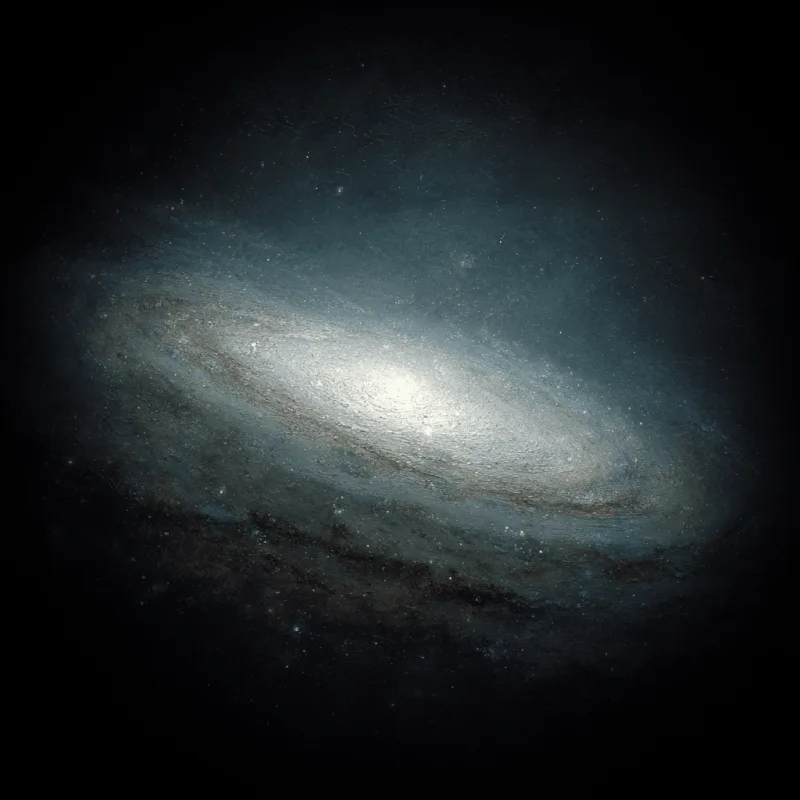
The nearest large galaxy, a smudge to the naked eye on a dark night and something like a trillion stars. It is moving towards the Milky Way. Whether the two will collide is less certain than it was.
On a clear, dark autumn night in the northern hemisphere there is a small oval of haze in the constellation of Andromeda that has been noted since at least the tenth century. It is the farthest thing most people will ever see unaided. The light arriving tonight left it about two and a half million years ago, before anyone of our kind was here to look up.
Until the 1920s it was not known to be a galaxy at all. It was catalogued as a nebula, a cloud inside our own Milky Way, and astronomers argued in public about whether the spiral nebulae were nearby or were island universes of their own. In 1923 Edwin Hubble found a variable star in it whose brightness, by a rule Henrietta Leavitt had worked out a decade earlier, gave away its distance, and the argument ended: it was far outside our galaxy, and the universe was very much larger than anyone had thought.
It is a spiral like the Milky Way, somewhat larger across, holding on the order of a trillion stars and dozens of small satellite galaxies. Seen in full it would cover about six times the width of the full moon, though only the bright core shows to the eye. Long-exposure photographs bring out the spiral arms and dark dust lanes.
It is coming towards the Milky Way at about a hundred and ten kilometres a second. Since the 2000s the two galaxies were expected to merge in roughly four billion years into a single large elliptical galaxy; more recent work, which weighs the pull of the other galaxies in the neighbourhood, puts the odds of a collision closer to even, and later if it comes. Even if they do collide, the stars are so far apart that almost none would hit, and the Sun would simply find itself in a different sky.
How long would it take to get there?
| Light | 2.5 million years |
|---|---|
| Parker Solar Probe, at its fastest | 3.9 billion years |
| Voyager 1 | 44 billion years |
| An airliner | 3 trillion years |
In Voyage a small ship makes this trip in somewhere between ten minutes and five hours. That is the game. This is the distance.
What the ship finds when it arrives here, and what it has learned by the time it leaves, is in the app. It is not written here.
A ship in Voyage is always on its way somewhere like this. It arrives whether or not anyone is watching.
Get Voyage on the App StoreFree to start. iPhone only.