
Layer 1 · Near-Earth Space
Aurora Borealis
About 120 kilometres from Earth.
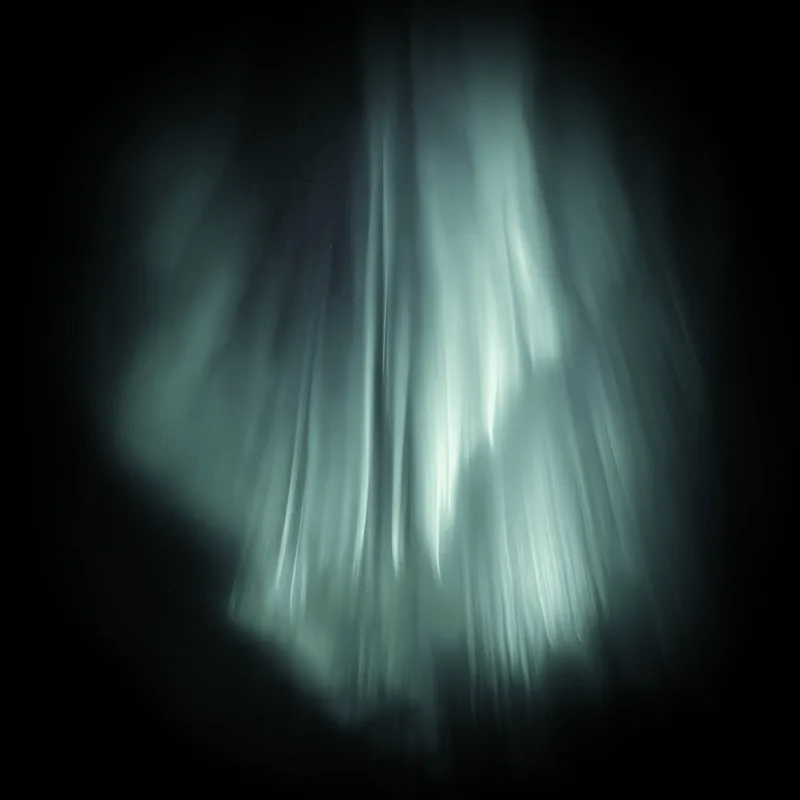
The Sun's wind, pressing on Earth's magnetic field, drives electrons into the upper air near the poles. The light is the air itself, glowing a hundred kilometres up.
The Sun sheds a thin wind of electrons and protons in every direction, and the Earth's magnetic field deflects most of it. But the wind drags on the field and stretches it out behind the planet into a long tail. Energy stored there is released in bursts, and electrons are thrown down the field lines towards the two magnetic poles. When they hit the upper atmosphere they excite the gas, and the gas gives the energy back as light.
Each gas gives its own colour. Oxygen glows green at around a hundred to a hundred and fifty kilometres up and a deep red higher still; nitrogen adds blues and purples along the lower edge. The bottom of a curtain is usually about a hundred kilometres above the ground, well above any weather and above where the air is thick enough to fly in.
Aurorae happen all the time in a ring around each magnetic pole, called the auroral oval. Most nights that ring sits over northern Scandinavia, Iceland, Alaska and Canada. When the Sun is active, and especially after a large eruption from the Sun, the ring swells and the lights reach much farther south. The Sun runs on an eleven-year cycle of activity, and the years around its peak bring the most displays.
From the space station, astronauts see the same curtains from the side and from above, hanging beneath the orbit rather than overhead, and now and then fly through the top of the red. Earth is not the only planet with them: Jupiter and Saturn both have permanent aurorae at their poles, larger than the whole of Earth.
How long would it take to get there?
| Light | under a second |
|---|---|
| Parker Solar Probe, at its fastest | under a second |
| Voyager 1 | 7.1 seconds |
| An airliner | 8 minutes |
In Voyage a small ship makes this trip in somewhere between ten minutes and five hours. That is the game. This is the distance.
What the ship finds when it arrives here, and what it has learned by the time it leaves, is in the app. It is not written here.
A ship in Voyage is always on its way somewhere like this. It arrives whether or not anyone is watching.
Get Voyage on the App StoreFree to start. iPhone only.