
Layer 0 · Getting Started
Hubble Space Telescope
About 500 kilometres from Earth.
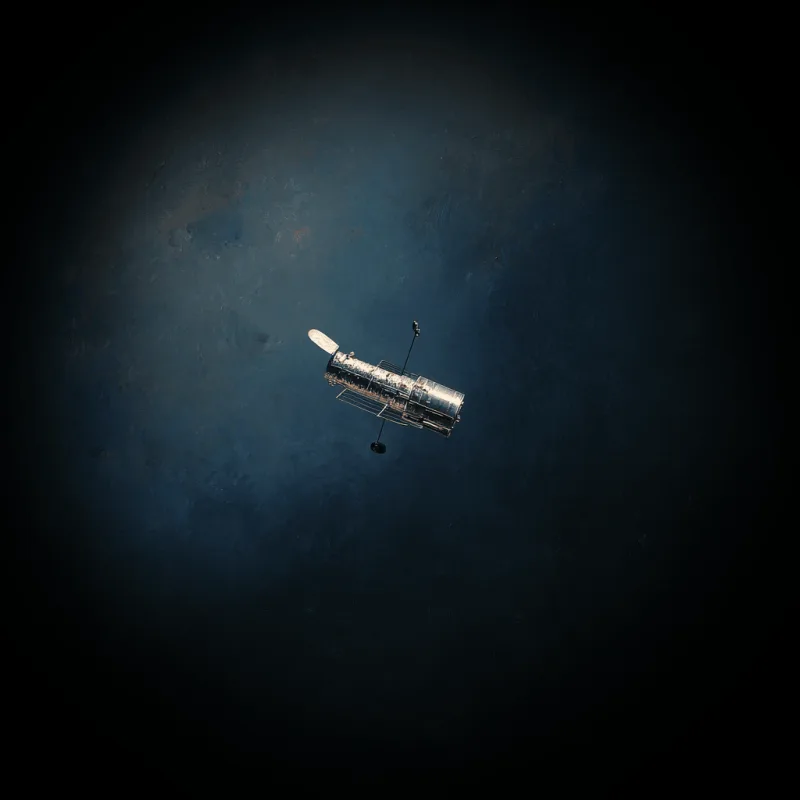
A telescope thirteen metres long that has been looking outward since 1990. Most of the pictures people carry of deep space came from it.
Hubble was carried up by the shuttle Discovery in April 1990 and placed about six hundred kilometres up, half again as high as the space station now flies, above the atmosphere that blurs every telescope on the ground. Its main mirror is 2.4 metres across, modest by the standards of mountaintop observatories, but a mirror that never has to look through air can see finer detail in visible light than a much larger one that does.
The first pictures were a disappointment. The mirror had been ground to the wrong shape by about a fiftieth of the width of a human hair, and the images came back soft. Three years later a shuttle crew installed corrective optics, and the telescope has been sharp since. Four more servicing visits followed, the last in 2009, swapping instruments, gyroscopes and batteries. There is no plan for another; the shuttle that made them possible was retired in 2011.
Its most consequential single image is a patch of apparently empty sky, stared at for ten days in 1995, that turned out to hold several thousand galaxies. Measurements made with it narrowed the age of the universe to within about ten percent, tracked the expansion of space, and found the first trace of an atmosphere on a planet around another star. Its successor, launched in 2021, sees in the infrared and complements it rather than replacing it.
Hubble is drifting slowly downward as the upper atmosphere drags on it, and without another lift it will re-enter sometime in the 2030s. Until then it keeps taking pictures, and many of the sky images people know best are still its.
How long would it take to get there?
| Light | under a second |
|---|---|
| Parker Solar Probe, at its fastest | 2.6 seconds |
| Voyager 1 | 29 seconds |
| An airliner | 33 minutes |
In Voyage a small ship makes this trip in somewhere between ten minutes and five hours. That is the game. This is the distance.
What the ship finds when it arrives here, and what it has learned by the time it leaves, is in the app. It is not written here.
A ship in Voyage is always on its way somewhere like this. It arrives whether or not anyone is watching.
Get Voyage on the App StoreFree to start. iPhone only.