
Layer 1 · Near-Earth Space
Karman Line
About 100 kilometres from Earth.
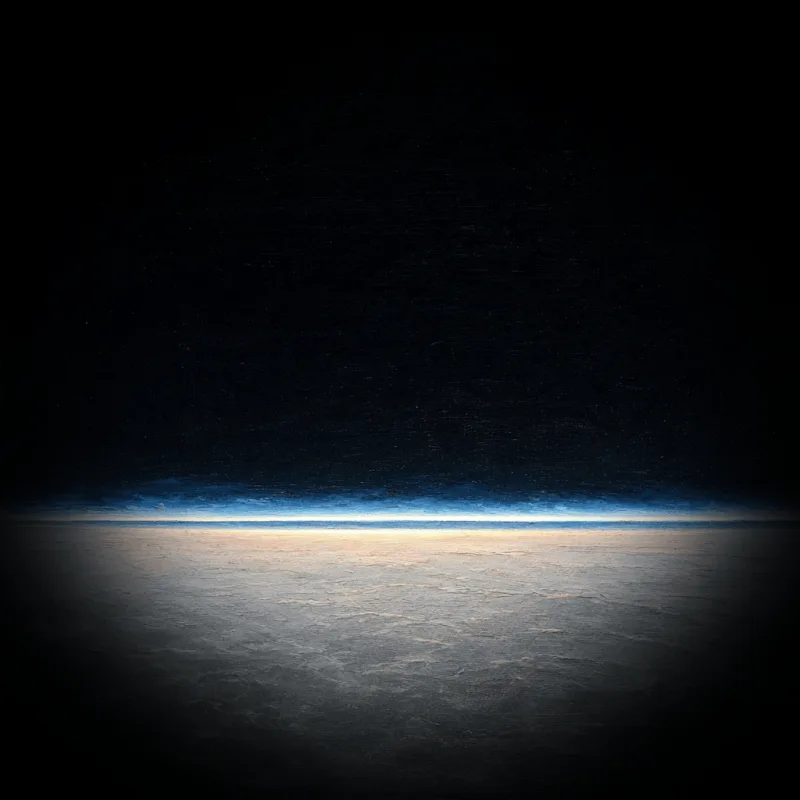
The altitude where the air is too thin to fly on and space is conventionally said to begin. There is no line there. It is a number people agreed on.
The atmosphere does not stop. It thins gradually, and there is measurable air hundreds of kilometres up, enough to drag on satellites and shorten their orbits. So the question of where space begins has no physical answer, only a practical one, and the one most of the world uses is a round hundred kilometres above sea level.
The name comes from Theodore von Kármán, a Hungarian-American engineer who in the 1950s worked out the altitude at which an aircraft would have to fly so fast to generate lift from the thin air that it would simply be in orbit. His own figure was lower, closer to eighty kilometres, but the international body that keeps aviation and spaceflight records settled on a round hundred instead, and the convention stuck.
Not everyone uses it. The United States counts spaceflight from fifty miles, about eighty kilometres, which is why some suborbital flights count as spaceflight on one side of the Atlantic and not on the other. The disagreement matters for records, for insurance and now for law, since no treaty has ever defined where a country's airspace ends and space begins.
Crossing it is now something a paying passenger can do. A suborbital rocket reaches it in a few minutes, offers a few minutes of weightlessness and a view of the curved horizon, and comes back down. It is the first mark a ship leaving Earth passes, and there is nothing at it to mark.
How long would it take to get there?
| Light | under a second |
|---|---|
| Parker Solar Probe, at its fastest | under a second |
| Voyager 1 | 5.9 seconds |
| An airliner | 6.7 minutes |
In Voyage a small ship makes this trip in somewhere between ten minutes and five hours. That is the game. This is the distance.
What the ship finds when it arrives here, and what it has learned by the time it leaves, is in the app. It is not written here.
A ship in Voyage is always on its way somewhere like this. It arrives whether or not anyone is watching.
Get Voyage on the App StoreFree to start. iPhone only.