
Layer 5 · Outer Solar System
Saturn
About 8.52 astronomical units from Earth.
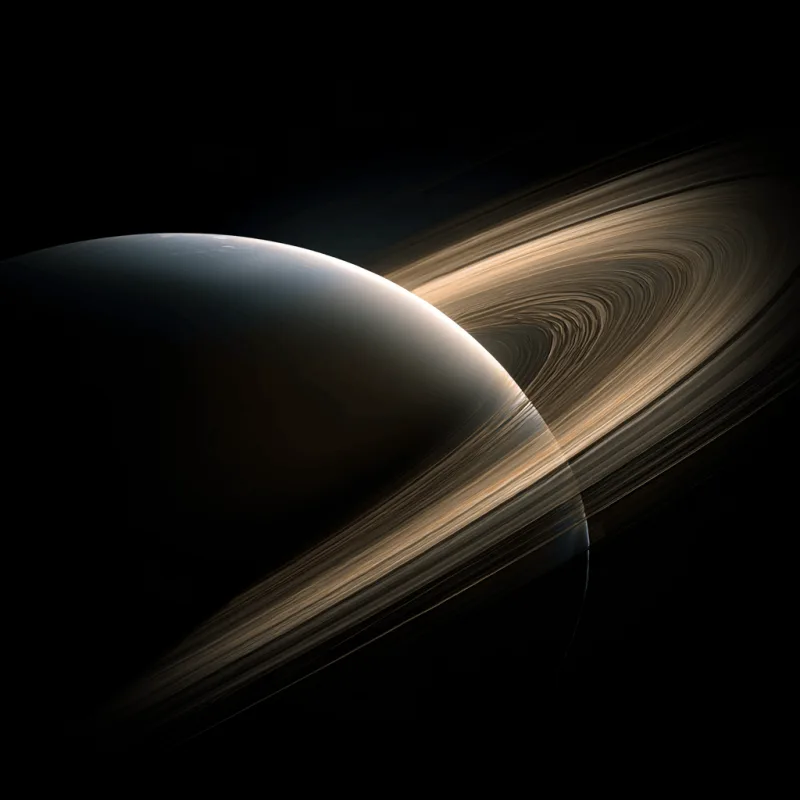
The sixth planet, with rings wide enough to span most of the distance from the Earth to the Moon and thin enough to vanish when seen edge-on. It is the farthest world anyone found before telescopes.
Saturn is a ball of hydrogen and helium about nine times wider than Earth, orbiting the Sun at roughly nine and a half times Earth's distance. A year there lasts twenty-nine of ours; a day is under eleven hours, fast enough to flatten the planet visibly at the poles. It is the only planet less dense than water.
The rings are almost entirely water ice, in pieces from dust grains to house-sized boulders, spread across a disc nearly three hundred thousand kilometres wide and in most places only about ten metres thick. Because the planet is tilted, the rings open and close as seen from Earth, and about every fifteen years they turn edge-on and all but disappear for a few weeks, as they did in 2025. They may be young by the standards of the solar system, possibly only a few hundred million years old, and are slowly raining down onto the planet.
Saturn has more known moons than any other planet, well over two hundred and seventy, most of them small rocks a few kilometres across. The largest has an atmosphere thicker than Earth's and lakes of liquid methane on its surface; a smaller one sprays water into space from cracks in its icy shell. Four spacecraft have visited, and one of them, Cassini, stayed for thirteen years before being flown into the planet in 2017 so that it could never contaminate those moons.
To the eye it is a steady yellowish star, and the rings show in any small telescope. For the whole of human history until 1781 it was the edge of the known solar system.
How long would it take to get there?
| Light | 1.2 hours |
|---|---|
| Parker Solar Probe, at its fastest | 2.5 months |
| Voyager 1 | 2.4 years |
| An airliner | 162 years |
In Voyage a small ship makes this trip in somewhere between ten minutes and five hours. That is the game. This is the distance.
What the ship finds when it arrives here, and what it has learned by the time it leaves, is in the app. It is not written here.
A ship in Voyage is always on its way somewhere like this. It arrives whether or not anyone is watching.
Get Voyage on the App StoreFree to start. iPhone only.